
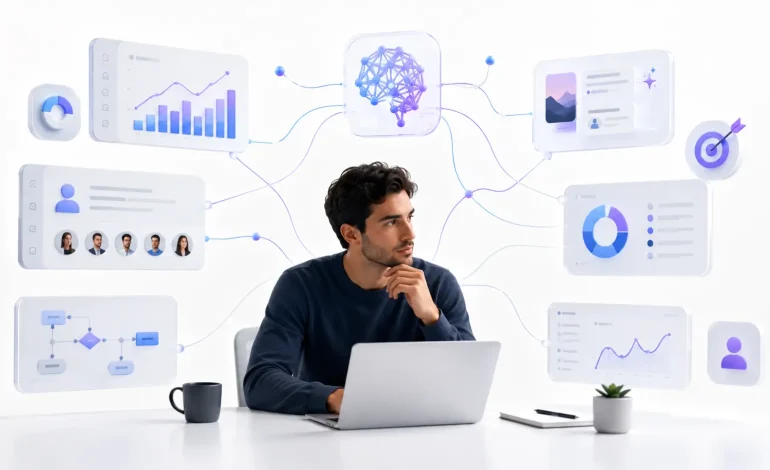
How AI Marketing Will Transform Teams by 2026

How AI Marketing Is Changing Marketing Teams in 2026
The landscape of marketing is undergoing a seismic shift, driven by the accelerated evolution of AI marketing. As I look ahead to 2026, it’s clear that marketing teams are grappling with a fundamental question: How do we balance the advanced capabilities of AI with the irreplaceable elements of human creativity? This article will explore the progression of AI in marketing, highlight what AI can replace and what it cannot, and discuss future trends that will shape marketing teams in the coming years.
The Evolution of AI Marketing
AI has transitioned from simple automation tools to sophisticated decision-making agents capable of processing vast amounts of data and making informed predictions. Initially, AI in marketing primarily focused on automating routine tasks such as email segmentation and basic analytics. However, its capabilities have expanded significantly, now encompassing predictive analytics, natural language processing, and advanced customer profiling.
For example, tools like Salesforce’s Einstein and HubSpot’s AI features have integrated AI into customer relationship management (CRM) systems, allowing marketers to better understand customer journeys and optimize engagement strategies. These platforms leverage machine learning to analyze historical customer interactions and predict future behaviors, thereby helping marketers tailor their communications more effectively. The introduction of AI-driven tools has not only enhanced operational efficiency but also reshaped the roles within marketing teams. Traditional roles are evolving; marketers are now expected to possess a hybrid skill set that includes both technical proficiency and creative insight.
As marketing teams adapt to these changes, they must also be aware of the impact AI has on their workflows. Many teams now utilize AI for tasks such as predictive lead scoring, enabling them to focus their efforts on high-potential opportunities rather than getting bogged down in data entry and analysis. For instance, AI algorithms can assess factors such as previous purchasing behavior, engagement with marketing materials, and even social media activity to rank leads based on their likelihood to convert. This shift allows for a more strategic allocation of resources, ultimately driving better marketing outcomes.
What AI Can Replace: Efficiency and Precision
AI excels in automating repetitive tasks, particularly in areas such as data analysis and audience segmentation. By leveraging machine learning algorithms, AI can analyze consumer behavior patterns and preferences at a scale that is impossible for human teams to achieve. This automation leads to enhanced efficiency and precision in marketing strategies.
Enhancements in Media Optimization: AI tools have revolutionized media optimization, allowing marketers to adjust campaigns in real-time based on performance data. For instance, programmatic advertising platforms utilize AI to analyze vast datasets and determine the best placements for ads, increasing the likelihood of conversion while minimizing costs. According to a report by Forbes, brands that utilize AI-driven media optimization have seen up to a 30% increase in ROI compared to those relying solely on traditional methods. This capability to optimize ad spend in real-time is a game changer, enabling marketers to allocate budgets more efficiently and maximize return on investment.
Moreover, statistical improvements in marketing outcomes attributed to AI implementation are noteworthy. A study by Vertex Plus highlighted that businesses employing AI in their marketing strategies experienced a 25% increase in customer engagement and a 20% reduction in churn rates. These metrics underscore the tangible benefits of incorporating AI into marketing operations. Furthermore, AI can facilitate hyper-personalization, tailoring marketing messages to individual users based on their past interactions and preferences. This level of personalization significantly increases the relevance of marketing messages and enhances customer satisfaction.
What AI Cannot Replace: The Human Touch
Despite its numerous advantages, AI cannot replicate the nuanced aspects of human creativity and emotional intelligence that are vital for effective marketing. Human insight remains irreplaceable in areas such as brand storytelling and relationship building. While AI can help analyze data and provide recommendations, it lacks the ability to generate authentic narratives that resonate with audiences on an emotional level.
Case Studies of Successful Human-AI Collaboration: Consider the success story of Coca-Cola, which integrated AI into its marketing strategy by using data analytics to inform creative campaigns. However, the final creative direction and storytelling remained firmly in human hands. The result was a campaign that not only leveraged data-driven insights but also connected emotionally with consumers, illustrating the powerful synergy between AI and human creativity. Similarly, the beauty brand L’Oréal has successfully employed AI to analyze customer preferences and trends, but the creative aspects of their campaigns—such as the formulation of compelling narratives and the design of visually striking advertisements—are still crafted by human marketers who understand cultural nuances and emotional triggers.
In addition, the importance of emotional intelligence in marketing cannot be overstated. AI may analyze customer feedback and sentiment, but it cannot empathize with customers’ experiences. This is where human marketers excel, as they can interpret emotions and craft messages that resonate deeply with their target audiences. The art of persuasion and connection is a distinctly human trait that AI is far from mastering. For instance, a human marketer can identify subtle shifts in consumer sentiment during a crisis, allowing them to pivot their messaging in a way that feels authentic and empathetic—something AI is not equipped to do.
Future Trends: Integrating AI with Human Expertise
As we look to the future, the role of marketing teams will continue to evolve in an AI-driven landscape. Predictions suggest that successful marketing teams will be those that can effectively integrate AI tools while preserving the essential human elements of creativity and emotional intelligence.
Strategies for Effective Integration: To achieve this balance, marketing teams should adopt a few key strategies: 1. Embrace a Hybrid Skill Set: Marketers must develop both technical skills to understand and leverage AI tools effectively and creative skills to craft compelling narratives and strategies. Continuous learning will be crucial in keeping pace with advancements in AI technology. This may involve pursuing certifications in data analytics or machine learning, alongside traditional marketing training. 2. Foster Collaboration: Encourage collaboration between data analysts and creative teams. By working together, these groups can create campaigns that are both data-informed and emotionally resonant, leveraging the strengths of both AI and human insight. For instance, regular brainstorming sessions that incorporate data analysis findings can lead to innovative campaign ideas that are grounded in real consumer behavior. 3. Invest in Training: Marketing professionals should invest in training programs that focus on AI literacy, data interpretation, and creative thinking. This investment not only enhances the team’s capabilities but also fosters a culture of innovation. Companies can bring in experts to conduct workshops or leverage online learning platforms to provide ongoing education. 4. Iterative Testing: Utilize AI to conduct A/B testing on creative campaigns. While AI can provide insights into which elements perform best, human intuition should guide the final creative decisions based on these insights. This approach ensures that marketing strategies are continually refined based on both data and human insight, leading to more effective campaigns over time.
The importance of continuous learning and adaptation for marketing professionals cannot be overstated. As AI technology continues to evolve, so too must the skills and strategies of marketing teams. Embracing change and viewing AI as a collaborator rather than a replacement will be key to thriving in this new landscape.
In conclusion, as we navigate the changing dynamics of marketing in 2026, it’s imperative for teams to strike a balance between the efficiency and precision offered by AI and the creativity and emotional intelligence that only humans can provide. By thoughtfully integrating AI into their strategies while recognizing the irreplaceable value of human insight, marketing teams can not only enhance their efforts but also create deeper connections with their audiences.
To explore how AI can enhance your marketing strategies while preserving the human touch, consider subscribing to our newsletter. We provide actionable insights and resources to help you navigate the evolving landscape of AI in marketing. Let’s ensure your marketing team is prepared for the future.