Essential Marketing KPIs Every CEO Cares About

The Marketing KPIs Every CEO Actually Cares About
When I consult with businesses, I frequently encounter a disconnect between marketing teams and the C-suite, particularly regarding the value of marketing efforts. Many marketing professionals find themselves drowning in operational metrics that, while interesting, do little to demonstrate their impact on revenue. This disconnect is particularly pronounced when the CEO focuses more on financial metrics than on marketing jargon. In this article, I will outline the critical Marketing KPIs that matter to CEOs and how marketing departments can position themselves as revenue generators rather than cost centers.
Understanding the CEO’s Perspective on Marketing Metrics
To effectively communicate the value of marketing, it’s crucial to understand the CEO’s viewpoint. CEOs prioritize metrics that reflect financial impact over operational details. They want to see how marketing contributes directly to the bottom line. This means that marketing departments must align their KPIs with business objectives, focusing on metrics that demonstrate their role in revenue generation.
For instance, consider a CEO reviewing the annual budget. If the marketing team presents extensive data on social media engagement without linking it to sales growth, the CEO may perceive marketing as an expense rather than a strategic investment. Therefore, understanding what drives CEO decision-making is key to framing marketing metrics in a way that resonates with executive leadership.
Common Misconceptions About Marketing Metrics
A significant misconception is that CEOs only care about sales figures. While these numbers are important, they often result from multiple factors, including marketing efforts. CEOs seek clarity and direct connections between marketing activities and financial outcomes. For example, if a marketing team presents a report indicating a spike in website traffic without linking that data to sales conversions, it does not resonate with the CEO’s priorities.
Furthermore, there’s a tendency to focus on vanity metrics—such as likes and shares—rather than actionable insights. CEOs want to understand how these metrics translate into customer behavior and, ultimately, revenue.
Aligning KPIs with Business Objectives
To gain credibility, marketing teams must articulate how their KPIs align with broader business goals. This requires a shift from traditional operational metrics (like impressions and clicks) to metrics that reflect customer engagement and revenue impact. For instance, if your business aims to increase market share, metrics like Customer Acquisition Cost (CAC) and Return on Marketing Investment (ROMI) become essential. These metrics not only indicate marketing efficiency but also demonstrate how marketing contributes to overall business growth.
Let’s take a technology company that aims to expand its market reach. Instead of merely reporting on the number of leads generated, the marketing team should focus on how those leads convert into paying customers and the costs associated with acquiring them. By presenting this information, they can effectively illustrate their contribution to the business’s strategic objectives.
Key Performance Indicators (KPIs) That Matter
As I work with various organizations to refine their marketing strategies, certain Marketing KPIs consistently emerge as critical indicators of success. Here are the top metrics that every CEO should care about:
Customer Acquisition Cost (CAC)
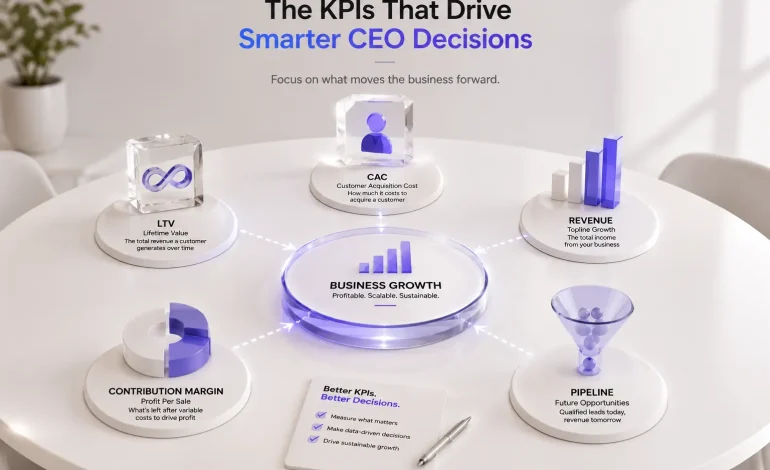
CAC is a straightforward measure of the efficiency of acquiring new customers. It’s calculated by dividing the total cost of sales and marketing by the number of new customers acquired in a given period. For example, if your company spent $100,000 on marketing and acquired 1,000 new customers, your CAC would be $100. A low CAC indicates that your marketing efforts are effective and that you’re using your resources wisely.
Moreover, understanding CAC in context is vital. For instance, a startup may have a higher CAC initially as it invests heavily in brand awareness, but if it can demonstrate that this investment leads to a sustainable customer base, it can justify the costs to the CEO.
Return on Marketing Investment (ROMI)
ROMI goes a step further by assessing the effectiveness of your marketing spend. It measures how much revenue is generated for every dollar spent on marketing. For instance, if your marketing department spends $50,000 and generates $200,000 in revenue, your ROMI would be 4:1. This metric provides clear evidence of marketing’s contribution to revenue, which is exactly what CEOs want to see.
To illustrate this, consider a retail brand that runs a promotional campaign. If the campaign costs $10,000 and results in $50,000 in sales, the ROMI reflects a strong return, thereby reinforcing the marketing department’s value to the CEO. This data can also be leveraged to secure future marketing budgets.
Customer Lifetime Value (LTV)
Understanding the long-term value of customers is crucial for any business. LTV estimates how much revenue a customer will generate throughout their relationship with your company. By comparing LTV to CAC, you can determine whether your customer acquisition strategies are sustainable. For example, if your LTV is $500 and your CAC is $100, you have a healthy 5:1 ratio, which indicates that your marketing efforts are likely profitable in the long run.
Moreover, recognizing factors that influence LTV, such as customer retention strategies or upselling opportunities, can provide deeper insights for the CEO. If a company can increase its LTV through enhanced customer service or loyalty programs, it can highlight the effectiveness of its marketing initiatives in fostering lasting customer relationships.
Linking Marketing Metrics to Revenue Growth
Tracking the connection between marketing metrics and revenue growth is essential for demonstrating the value of marketing to the CEO. Here’s how you can effectively link these metrics:
Tracking Marketing’s Contribution to Revenue
One of the most effective ways to demonstrate marketing’s impact on revenue is by tracking sourced leads and influenced sales. Sourced leads are those that come directly from marketing efforts, while influenced sales are those where marketing played a role in the customer journey, even if they didn’t directly initiate the sale. By using tools like CRM systems, you can create a clear picture of how marketing activities lead to revenue.
For example, a company could implement a tracking system that categorizes leads based on their source—be it email campaigns, social media, or paid advertising. By analyzing which sources yield the highest conversion rates, marketing can refine its strategies while providing the CEO with actionable insights.
Demonstrating ROI
Securing ongoing marketing budgets necessitates demonstrating ROI. For example, if a new campaign results in a 20% increase in sales, presenting the data in terms of revenue generated versus costs incurred will show your CEO that marketing is a worthwhile investment. This data-driven approach not only builds credibility but also fosters trust between the marketing department and executive leadership.
Additionally, consider creating a dashboard that visualizes this data for easy reference. By regularly updating the dashboard with real-time metrics, you can keep the CEO informed and engaged with the marketing performance.
Case Studies of Successful Marketing Strategies
Consider the case of a SaaS company that implemented an account-based marketing (ABM) approach targeting high-value clients. By aligning its marketing strategy with sales goals, the company successfully reduced CAC by 30% while increasing LTV by 50% over two years. This case clearly illustrates how aligning marketing efforts with business objectives can lead to significant revenue increases.
In another instance, a consumer goods company that invested in customer segmentation was able to tailor its marketing messages effectively, leading to a 15% increase in customer retention rates. This not only enhanced LTV but also provided clear, quantifiable results that the CEO could appreciate.
Tools and Strategies for Effective Measurement
To measure these critical Marketing KPIs effectively, you need the right tools and strategies in place. Here are some best practices:
Utilizing Marketing Automation and CRM Tools
Investing in marketing automation and CRM tools is essential for gathering and analyzing data. Platforms like HubSpot, Marketo, and Salesforce can help you track customer interactions and measure the impact of your marketing efforts on sales. These tools enable you to automate reporting, making it easier to present data to your CEO and other stakeholders.
Moreover, leveraging analytics tools can provide insights into customer behavior, allowing marketing teams to make informed decisions. For instance, analyzing customer journey mapping can reveal where potential customers drop off, enabling the marketing team to address those gaps effectively.
Best Practices for Reporting Metrics
When reporting metrics to CEOs and stakeholders, clarity is key. Present data in a way that highlights the most important information first. Use visual aids like graphs and charts to make complex data easier to digest. For example, rather than presenting raw data, show trends over time that correlate marketing efforts with revenue growth. This approach makes it easier for your audience to grasp the significance of the data.
Additionally, consider using storytelling techniques to convey the data. For example, instead of simply stating that a campaign was successful, tell the story of how it evolved and the impact it had on real customers. This narrative can help make the data more relatable and impactful for the CEO.
Continuous Improvement through Data-Driven Decision-Making
Finally, adopting a culture of continuous improvement through data-driven decision-making is essential. Regularly review your marketing metrics and adjust strategies based on what the data reveals. For instance, if you notice that certain channels yield a higher ROMI, focus your efforts there while reducing investment in less effective areas. This iterative approach ensures that your marketing strategies evolve in alignment with business growth objectives.
Encouraging a feedback loop where insights from sales and customer service teams are incorporated into marketing strategies can further enhance effectiveness. This collaboration fosters a holistic view of customer interactions and strengthens the overall marketing approach.
Conclusion
In summary, aligning marketing metrics with business objectives is not just beneficial; it’s essential for marketing departments to be seen as revenue generators rather than cost centers. By focusing on Marketing KPIs like CAC, ROMI, and LTV, marketing teams can clearly demonstrate their impact on revenue growth. To facilitate this alignment, invest in the right tools, adopt best practices for reporting, and commit to continuous improvement.
If you’re looking to assess your current marketing metrics and ensure they align with your business growth objectives, I invite you to subscribe to my newsletter for actionable insights and resources tailored to your needs. Let’s transform your marketing strategy into a powerhouse for revenue generation.