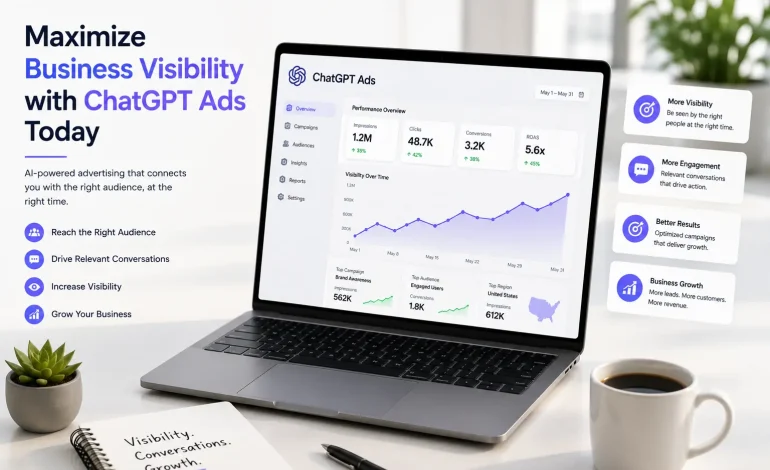
Maximize Business Visibility with ChatGPT Ads Today

Maximizing Business Visibility in the Age of AI Search: A Guide to ChatGPT Ads
Understanding the AI Search Landscape
The emergence of AI-driven search engines like ChatGPT ads fundamentally reshapes how consumers discover businesses. Traditional search engines primarily rely on keyword matching and backlinks to determine search rankings. However, AI search engines leverage advanced algorithms that interpret user intent, context, and conversational nuances. This shift means that businesses must rethink their marketing strategies. The challenge is clear: if you fail to adapt to these AI-driven discovery mechanisms, you risk losing visibility and, consequently, potential revenue.
Research indicates that users increasingly turn to conversational AI for information and recommendations. According to OpenAI, ChatGPT is designed to provide engaging and relevant responses, making it a crucial platform for businesses aiming to enhance their visibility. This shift necessitates a focused strategy that aligns with these new discovery methods, ensuring that your business is not merely a footnote in the conversation but a featured participant.
To illustrate, consider how consumer behavior has shifted over the last few years. A survey conducted by Pew Research Center showed that nearly 46% of Americans reported using AI tools for various information-seeking tasks. This trend is not limited to younger demographics; older adults are also increasingly adopting these technologies for everyday inquiries. As a result, businesses must recognize that their target audience engages with AI in ways that traditional marketing techniques may not address effectively.
Leveraging ChatGPT Ads for Increased Visibility
Setting up and optimizing ChatGPT ads is a practical step to enhance your business visibility. Here’s a step-by-step guide:
1. Define Your Target Audience: Understand who your customers are, what they need, and how they interact with AI. This foundational step ensures that your ads are tailored to the right demographic. For example, if your business targets millennials, consider incorporating trends and language that resonate with that group. 2. Create Engaging Ad Content: Your ad copy should be succinct, informative, and engaging. Highlight key benefits and features of your products or services, using language that resonates with your audience. For instance, if you’re a fitness studio, instead of simply stating, “Join our classes,” you could say, “Looking to kickstart your fitness journey? Join our community-focused classes and get your first week free!” 3. Optimize for AI Algorithms: Use natural language patterns and questions that users might ask. For example, instead of merely stating “Best coffee in town,” you might frame it as “Looking for the best coffee in town? Try our artisanal blends!” This approach helps the AI understand your content better and connects with users on a conversational level. 4. Utilize Visual Elements: Incorporate images or videos that can capture attention quickly. Visual content often enhances engagement rates, thereby improving your ad’s performance. Research shows that ads with rich media can generate up to 7 times more engagement than text-only ads. 5. Monitor and Adjust: After launching your ads, continuously monitor their performance. Use A/B testing to identify which variations yield the best results, and adjust your strategy accordingly. For instance, if one version of your ad generates significantly more clicks, analyze its elements and consider applying similar strategies to future ads.
Best practices for ad content include using conversational language, asking questions, and integrating call-to-action phrases that encourage user engagement. For instance, if you’re a local bakery, instead of a generic ad, you might say, “Craving fresh pastries? Stop by for a free sample today!” This approach appeals to AI algorithms and resonates with potential customers by addressing their immediate needs.
Creating Content that Appeals to AI Recommendations
In addition to ChatGPT ads, your website content plays a significant role in enhancing your discoverability in AI search environments. Here are strategies to develop clear and structured content:
– Utilize Clear Headings and Subheadings: Structure your content with headings that clearly indicate what each section is about. This structure aids both human readers and AI algorithms in navigating your content efficiently. For example, if you’re writing about different types of insurance, use headings like “Home Insurance Basics” and “Tips for Choosing Car Insurance” to guide readers. – Incorporate Authority Signals: Include credentials, testimonials, and links to reputable sources. Authority signals can significantly boost your credibility in the eyes of both users and AI recommendations. For instance, a law firm could showcase client testimonials and notable case wins to demonstrate expertise and reliability. – Develop FAQs: Address common questions related to your business. FAQs enhance user experience and serve as valuable content for AI algorithms, improving your chances of appearing in relevant searches. If you run a plumbing service, a well-structured FAQ section could answer questions like, “What should I do if my sink is clogged?” or “How often should I have my plumbing inspected?” This approach positions your business as a knowledgeable entity and increases the likelihood of appearing in AI-generated responses.
Utilizing Structured Information for Better AI Indexing
Structured data is critical in improving your visibility in AI-driven searches. It refers to a standardized format for providing information about a page and classifying the page content. Here’s how to implement structured information effectively:
– Use Schema Markup: Implement schema markup on your website to help search engines understand your content better. This can include details about your business, such as location, hours of operation, and services offered. For example, a dentist’s office might include schema that highlights services like teeth whitening and emergency care. – Create Rich Snippets: When you use structured data, search engines can display rich snippets that provide users with more information at a glance, enhancing click-through rates. Rich snippets can include star ratings, pricing information, and availability, making your content more appealing. – Optimize for Local Search: If your business has a physical location, ensure that your structured data includes local information. This increases your chances of appearing in localized AI search results. A local restaurant could use structured data to highlight its menu, hours of operation, and customer reviews. This approach aids in AI indexing and provides potential customers with useful information before they even visit your site.
Measuring Success: Analytics and Adjustments
Finally, tracking and measuring the effectiveness of your ChatGPT ads and content strategies is crucial for continuous improvement. Here are some tools and metrics to consider:
– Analytics Tools: Utilize platforms like Google Analytics, which provide insights into user behavior, traffic sources, and conversion rates. Monitoring these metrics allows you to understand which strategies work and which don’t. For example, if a specific ad campaign drives more traffic but results in fewer conversions, it may require a reevaluation of the landing page. – Ad Performance Metrics: Track key performance indicators (KPIs) for your ads, such as click-through rates (CTR), cost per acquisition (CPA), and return on ad spend (ROAS). These metrics help you assess the effectiveness of your ad campaigns. A high CTR but low conversion rate may indicate a mismatch between the ad message and the landing page content. – User Engagement: Analyze how users interact with your content and ads. Metrics such as time spent on page and bounce rates can indicate whether your content resonates with your audience. Adjust your content strategy based on these insights to enhance user engagement. For instance, if users frequently exit your site after viewing the homepage, consider revising it to better capture their interests. – Iterate Based on Data: Use the insights gained from analytics to iterate on your strategies. If certain ad variations or content types perform better, double down on those while phasing out less effective approaches. For instance, if you notice that a particular ad copy yields a higher CTR, analyze why that might be and replicate its elements in future campaigns. Continuous iteration based on data is key to maintaining and enhancing visibility in the AI search landscape.
Conclusion
In summary, maximizing your business visibility in an AI-driven search environment requires a proactive and structured approach. By leveraging ChatGPT ads, creating content that appeals to AI recommendations, utilizing structured information, and measuring success through analytics, you can position your business favorably in this new landscape. The strategies outlined here are not just theoretical; they are actionable steps that can yield tangible results.
If you’re ready to start implementing these strategies and boost your business visibility in AI search environments, consider signing up for my newsletter. You’ll receive regular insights and resources tailored to help you navigate the evolving marketing landscape effectively. Don’t miss out on the opportunity to stay ahead in the game.