How ChatGPT Ads Transform Customer Discovery

How ChatGPT Ads Could Change the Way Customers Discover Businesses
The Evolution of Customer Discovery
The landscape of customer discovery has been in flux for years, primarily due to technology’s rapid advancement. The shift from keyword-based searches to conversational AI interactions marks a significant turning point in how consumers research and discover products. Traditional search engines operated on a simple premise: users input keywords and receive a list of links that supposedly match their intent. This method, while effective for a time, has significant limitations in understanding nuanced user intent.
With the advent of AI tools like ChatGPT, this paradigm is shifting. Instead of sifting through a page of search results, customers can now engage in a dialogue with AI. This conversation-driven approach allows for a deeper understanding of user needs. For instance, a customer might ask, “What are the best running shoes for flat feet?” rather than entering a generic search term like “running shoes.” This query is far richer in context and intent, allowing AI to provide tailored recommendations based on a broader set of criteria, such as user preferences, budget, and specific requirements.
Understanding user intent within these conversational contexts is paramount for businesses. Companies that fail to grasp this shift may find themselves losing ground to competitors who can effectively engage in these dialogues. A study by McKinsey found that businesses prioritizing customer experience can see revenue growth of 5-10% higher than their competitors. Adapting to this new mode of discovery will not only enhance customer engagement but can also lead to measurable business growth. Additionally, the ability to respond to specific user queries in real-time can significantly improve the overall customer experience, fostering brand loyalty and repeat business.
The Mechanics of ChatGPT Ads
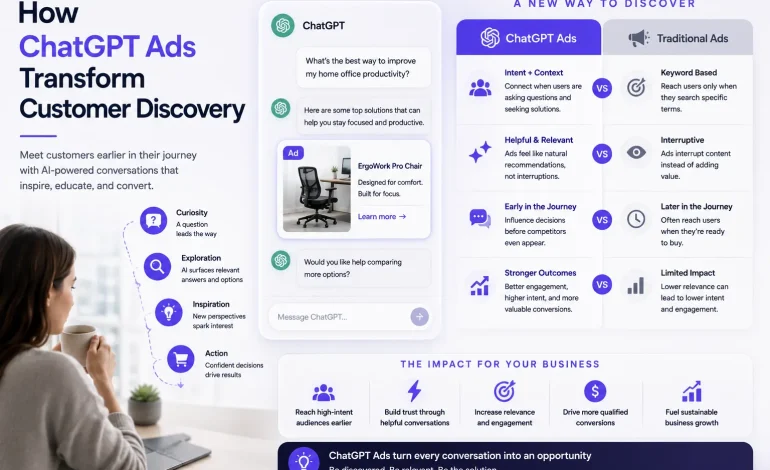
So, how do ChatGPT ads function within this new conversational framework? Unlike traditional advertising, which often relies on interruptive tactics, chatgpt ads are designed to integrate seamlessly into the user’s dialogue with the AI. For instance, if a user discusses their need for a new laptop, ChatGPT can interject with a relevant ad based on the conversation’s context. This form of contextual advertising represents a paradigm shift in how brands can reach their audiences.
The difference between traditional advertising and conversational ads lies primarily in the execution. Traditional ads are often static and one-dimensional, whereas ChatGPT ads can adapt and respond to user inquiries dynamically. If a user expresses interest in a particular feature of a product, the ad can adjust to highlight that feature, providing a more personalized experience. For example, if a customer mentions that they value battery life, the ad can showcase laptops with long-lasting batteries, thus increasing the likelihood of conversion. This level of customization is not just a luxury; it’s rapidly becoming a necessity in an increasingly competitive market.
Moreover, the potential for contextual advertising based on user queries means that businesses can achieve higher engagement rates. A report from eMarketer indicates that personalized ads can lead to conversion rates that are 10 times higher than their generic counterparts. This statistic underscores the importance of leveraging AI to craft messages that resonate with individual users. As such, businesses must start thinking beyond traditional advertising methodologies and consider how conversational ads can become a core part of their digital strategies.
Implications for Businesses
The implications for businesses are vast and multifaceted. Firstly, there is a clear necessity for companies to enhance their content quality and digital presence. In a world where AI-driven conversations are becoming the norm, businesses that invest in high-quality, relevant content will better position themselves to take advantage of this trend. Content must not only be informative but also structured in a way that AI can easily parse and utilize in conversations. For instance, businesses should consider employing structured data markup to improve how their content is understood by AI, enhancing its discoverability in conversational contexts.
Secondly, leveraging AI recommendations can significantly boost lead generation. Businesses can use AI algorithms to analyze customer interactions and predict which products or services are most likely to resonate with specific user segments. This predictive capability allows for more targeted marketing efforts, which can dramatically improve ROI. Companies like Amazon have successfully employed AI-driven recommendations, resulting in increased sales and customer satisfaction.
However, it’s essential to maintain trust and user experience in advertising. With the rise of AI in advertising, consumers are becoming increasingly aware of how their data is used. A study published in the Journal of Marketing Research highlights that trust is a critical factor in consumer decision-making. Businesses must ensure transparency in their advertising practices and offer users control over their data to foster trust and encourage engagement. This could include options for users to opt-in or opt-out of data tracking, as well as clear communication about how their data will be utilized to improve their experience.
Preparing for the Future of Advertising
As the landscape evolves, businesses need to adopt strategies to stay ahead. Here are several actionable strategies for businesses to consider as they prepare for the future of advertising in the context of ChatGPT ads:
1. Invest in AI Literacy: Understanding how AI works is crucial. Businesses should invest in training their teams on AI technologies and how these can be integrated into their marketing strategies. This knowledge will empower teams to create more effective campaigns tailored to conversational interfaces. Workshops, online courses, and partnerships with AI experts can facilitate this learning process.
2. Focus on Analytics and Measurement: The role of analytics in optimizing ad performance cannot be overstated. Businesses should establish robust measurement frameworks to track the effectiveness of their conversational ads. This includes understanding metrics like engagement rates, conversion rates, and customer feedback. Tools like Google Analytics or custom dashboards can provide valuable insights into user behavior and ad performance. By analyzing this data, businesses can continuously refine their strategies to maximize impact.
3. Anticipate Changes in Customer Behavior: As consumer preferences continue to evolve, businesses must remain agile. Analyzing trends in customer behavior will allow businesses to pivot their strategies as needed. For instance, if data indicates that users are increasingly seeking information through voice queries, businesses should adjust their content to optimize for voice search. This could involve creating content that directly answers common voice search questions or utilizing schema markup to improve visibility in voice search results.
4. Create Conversational Content: Content should be designed with a conversational tone and structure. This involves thinking about how users might phrase their questions and ensuring that content is readily accessible in a chat format. Tools like AnswerThePublic can help identify common queries that potential customers may have. Additionally, employing natural language processing (NLP) techniques can enhance the ability of content to resonate with user queries.
5. Build Trust Through Transparency: As mentioned earlier, trust is critical. Businesses should openly communicate their data usage policies and ensure that users are aware of how their information is utilized. This transparency can lead to higher engagement and loyalty from customers. Regularly updating users on privacy practices and providing clear channels for feedback can further enhance trust.
The transition to AI-driven advertising is not merely a trend; it’s a fundamental shift in how businesses interact with consumers. Companies that recognize this change and adapt their strategies accordingly will be better positioned to capture market share and drive growth in the coming years. The opportunity is clear: the integration of ChatGPT ads into marketing strategies is not just beneficial; it’s imperative for survival in a rapidly changing digital landscape.
For businesses looking to navigate this new terrain, I encourage you to subscribe to my newsletter, where I share insights, strategies, and actionable resources tailored to help you optimize your digital presence for the future of advertising. Don’t miss the chance to prepare for what’s next in AI-driven customer discovery and advertising.